 Wigan Council Good Trader Scheme

From front garden to finished driveway
We took out the garden and the old wall, built a new stone base, and laid the drive on top. Paul filmed each stage on his phone, so you can see exactly how a job like this gets built — no showreel, no stock footage.
Extra space, right next to your home.
Turning the front garden into a drive gives you parking on your own property, right next to the house — no more leaving the car on the road or down the street. It makes the front of the house look cared for, too, and the whole drive is designed from scratch: the right depth of stone, the right levels, and edging that holds everything in place.
Taking out what is there is part of every job, so it does not change the price. What made this one economical was the finish: one-size paving is the cheapest paving we lay, and on a drive this size it keeps the price down without cutting corners on the base underneath.
That does not make every garden job simple. Slopes, retaining walls, drains and services all affect how a drive is built, and some things cannot be checked from above — the depth of drains and services only becomes clear once we start digging. We plan for what we can see, and deal with anything we find as we go.
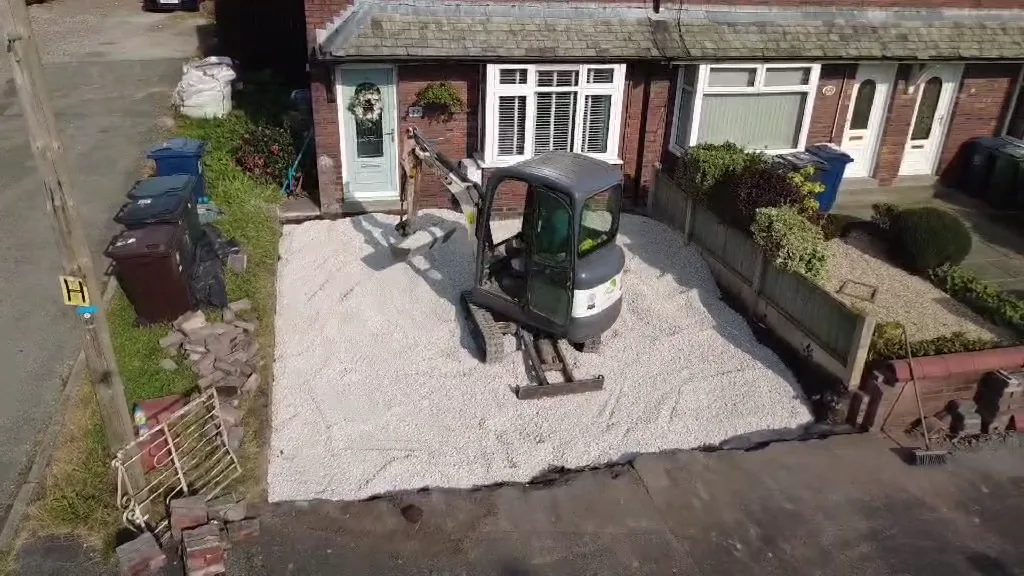
Out comes the garden and the wall.
The digger strips the grass, the soil and the old wall footings, and the spoil is loaded straight out. This is where we find out what is actually under the garden — roots, old drains, sometimes a bit of rubble — and where the finished level gets set from the kerb.
- Garden, soil and old wall removed in one go
- Spoil taken away, not left on your front
- Anything we uncover underground is dealt with before the base goes down
Stage 1: the garden and the old wall come out, and the spoil is loaded away.
Building the stone base.
The base is the part you never see, and the part that matters most. A Topstop separation membrane goes down first, so the new stone does not sink into the old sub-base. Then clean limestone — MOT Type 3 — is tipped and compacted in layers. It is clean stone with no fines, so water filters straight through it. The levels are set true for a flat, even finish, and the edging goes in before a single block is laid.
- Clean limestone sub-base (MOT Type 3) — water filters through it
- Stone compacted in layers, not tipped in one heap
- Edging bedded in before the paving goes down
Stage 2: Topstop separation membrane, stone and compaction — the base that carries the drive.
The finished drive.
Blocks laid to the pattern, edges cut in, joints brushed through with 6mm clean stone and the site cleaned down. There was no driveway here before — now she can park safely off the road, right next to her house, with the kerb appeal the whole street can see.
Stage 3: the finished drive — blocks, cuts, joints and a clean handover.
One of our most economical drives — because of the finish, not a shortcut.
This one is laid in one-size paving, the cheapest finish we offer, on a properly built stone base. What yours costs depends on the size, the access, what we find under the ground and the finish you choose. There are no prices on this page on purpose: Paul measures up, shows you the samples and puts a written price in front of you after the free survey. For a rough guide before then, the calculator on the site will give you a ballpark.
Turning a front garden into a drive? If the new surface is over 5m² and isn't permeable, the rainwater has to drain to a soakaway or your garden — not the street. Read the 5m² guide.
Before you book a survey.
Is it cheaper to turn a garden into a driveway than replace an old drive?
Taking out what is there is part of every job, so it does not change the price. What drives the cost is the size, the access, the ground and the finish you choose — and one-size paving is our cheapest option, and still looks smart years later.
Do I need planning permission to turn my front garden into a driveway?
If the drive is permeable, you usually do not need it. If it is not permeable, you do — so we design it permeable wherever the ground allows. A dropped kerb is a separate application to the council. Either way, we talk you through it at the survey and can handle the application if one is needed.
How long does a garden-to-driveway job take?
This one took a week from start to finish. Smaller drives can be quicker and bigger ones take longer, but Paul will give you a realistic start date and timescale in writing before any work begins, and keep you posted while we are there.
Got a garden you don't use?
A free survey costs nothing and there's no pressure to say yes. If planning permission is needed, we can sort that too — and Paul will give you a start date and a written price before any work begins.